1
/
of
1
Grace Scientific Corporation
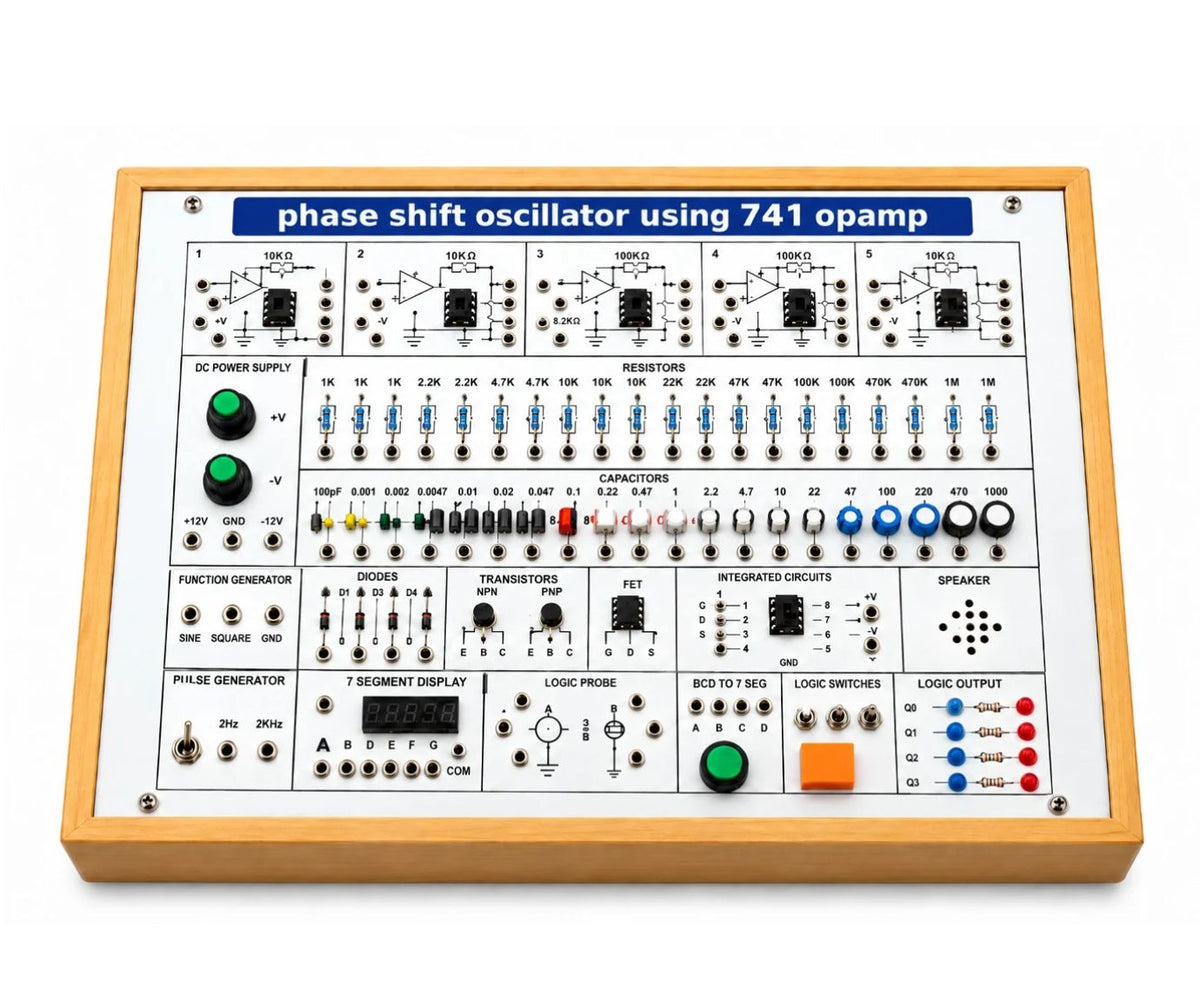
GSC-PE-202 - To Design And Construct Phase Shift Oscillator Using 741 opamp
GSC-PE-202 - To Design And Construct Phase Shift Oscillator Using 741 opamp
Regular price
Rs. 0.00 INR
Regular price
Sale price
Rs. 0.00 INR
Taxes included.
Shipping calculated at checkout.
Dispatch Lead Time:
Quantity
Couldn't load pickup availability
Specifications:-
Laboratory Setup – Phase Shift Oscillator Using 741 Op Amp
General Requirements
·Trainer provided with inbuilt power supply, breadboard, and inbuilt function generator
·Capable of studying different configurations of operational amplifiers: non-inverting, inverting, buffer, comparator, adder, subtractor, Phase shift oscillator
·Suitable for classroom and laboratory use with durable construction and clear labeling
Technical Specifications
ØFixed DC Power Supply
§+12 V regulated
§ –12 V regulated
§+5 V regulated
§ –5 V regulated
ØVariable DC Power Supply
§o +1.5 V to +10 V regulated (LM317)
§o –1.5 V to –10 V regulated (LM337)
ØFunction Generator
§Waveforms: sine, square, triangular
§Frequency range: 1 kHz to 100 kHz
§Output amplitude: 0–5 Vpp adjustable
ØOperational Amplifier IC
§uA741 (2 nos.)
§All pins terminated by 2 mm banana sockets
ØResistor Bank
§SMD resistance 1 kΩ, 1% ¼ W (5 nos.)
§SMD resistance 10 kΩ, 1% ¼ W (5 nos.)
§SMD resistance 100 kΩ, 1% ¼ W (5 nos.)
ØDiode
§1N4007
ØCapacitor Bank
§Electrolytic capacitor: 1 μF / 63 V
§Disc capacitors: 1 nF / 63 V, 10 nF / 63 V, 100 nF / 63 V
ØVariable Resistance Bank
§1 kΩ single-turn potentiometer (2 nos.)
§10 kΩ single-turn potentiometer (2 nos.)
§100 kΩ single-turn potentiometer (2 nos.)
§1 MΩ single-turn potentiometer (2 nos.)
Functional Capabilities
§Non-inverting amplifier
§Inverting amplifier
§Buffer (voltage follower)
§Comparator
§Adder (summing amplifier)
§Subtractor (differential amplifier)
§Phase Shift Oscillator
Classroom / Laboratory Teaching Content
§Training setup includes learning modules on Analog Electronics and Digital Electronics
§Content covers:
§Electronic components
§Series and parallel circuits
§Voltage divider and current divider circuits
§Circuit analysis
Share